


Would A Social Media Age Gate For Youth Under 16 In Canada Violate Their Charter Rights? A Parent Focused Look

Caveat: This article is not legal advice, it’s intended to provide parents, caregivers, and educators with a clearer understanding of how Canadian law may approach a rapidly evolving issue.
It is also important to recognize that this is not just a theoretical discussion. Similar arguments are already being tested in other parts of the world. In Australia, for example, a number of young people have launched a legal challenge to that country’s social media age-gating legislation through its highest courts. Their case raises many of the same questions being discussed here in Canada, particularly around child rights, proportionality, and whether broad restrictions are the most effective way to address online risk.
What happens in jurisdictions like Australia may not directly determine what Canadian courts will decide, but it does offer an early look at how these legal and societal tensions are beginning to play out in real time. For parents and caregivers, this reinforces an important point. The conversation around youth, technology, and the law is not settled. It is actively unfolding, both here at home and internationally.
Across Canada, the political theatre is growing surrounding discussions about restricting access to social media and AI for youth under 16 (1)(2)(3). The intent is clear, many adults want to reduce harm and create safer online spaces for young people. However, when we move from intention to implementation, especially in a country with constitutional protections, the conversation becomes more complex. One of the important questions not being discussed publicly is:
“Would restricting access to social media for youth under 16 infringe on their Charter Rights here in Canada?
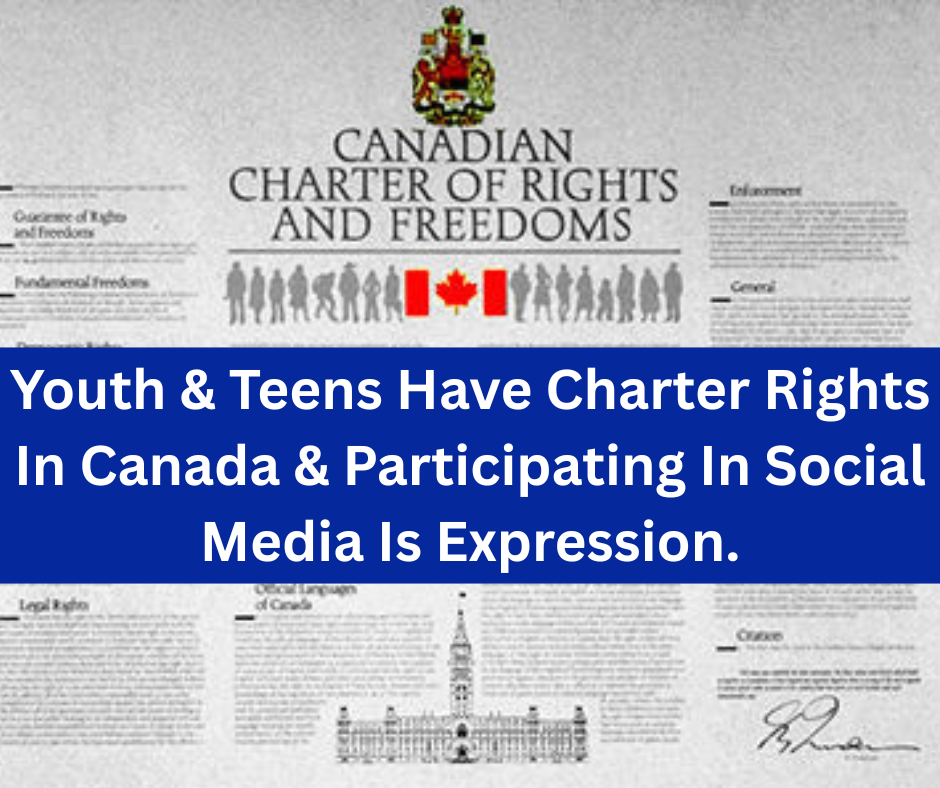
In Canada, freedom of expression is protected under the Canadian Charter of Rights and Freedoms (4). This protection is not limited to adults, it applies to young people as well. Expression today is not just about speaking or writing, it can also includes:
Posting content
Sharing opinions
Creating videos
Participating in online communities
As the Canada Research Chair in Internet and E-commerce Law, University of Ottawa Michael Geist stated in a recent article he published (5)
“Section2(b) of the Charter of Rights and Freedoms protects freedom of expression, with the result that a law blocking an entire age cohort from lawful platforms necessarily restricts a Charter-protected interest of the very people the legislation claims to protect”
Michele Geist further stated in his article that:
“The UN Committee on the Rights of the Child affirmed in General Comment 25 (2021) that children’s rights apply in the digital environment and include rights to information, expression, association, and participation, and the academic and policy literature on age-appropriate design has built on that foundation in arguing that children’s rights are a constraint on regulators as much as on platforms”
For many youth and teens, social media is not just entertainment, it’s where they connect, learn, explore identity, and sometimes even find support during difficult moments. Because of this, restricting access to social media would likely be viewed, from a legal standpoint, as a limit on a young person’s ability to express themselves. However, that is only the starting point in Canadian law, because rights can be limited, if the limit Is justified
Canada’s Charter is designed to balance individual freedoms with broader societal interests. Under Section 1 of the Canadian Charter of Rights and Freedoms, governments can limit rights if they can show that the restriction is reasonable and justified in a free and democratic society. To determine this, courts use what is known as the Oakes test. In plain language, the government would need to show:
There is a serious problem worth addressing
The law is actually connected to solving that problem
The approach does not go further than necessary
The benefits outweigh the harms
This is where the real debate begins. From a parenting perspective, it is easy to understand the desire to “just remove the risk.” However, from a legal and practical standpoint, broad restrictions often raise important concerns such as:
Is it too broad?
One of the first concerns courts often examine is whether a law is too broad in how it is applied. A blanket ban on social media for all youth under the age of 16 assumes that every young person presents the same level of risk and requires the same level of restriction. In reality, that is rarely the case. Teens develop at different rates, come from different home environments, and use technology in very different ways. Some may be passive consumers, while others are actively creating, learning, and connecting in meaningful and positive ways online.
Because of this, courts will often ask a more nuanced question, “Is a full ban the only way to address the concern, or could the same objective be achieved through more targeted and less restrictive measures?” This is where the focus begins to shift away from simply limiting access and toward improving the environments youth are engaging with.
For example, rather than removing access entirely, governments could look at requiring safer platform design or better content moderation. That might include limiting features like autoplay, infinite scrolling, or constant push notifications, all of which are intentionally built to keep users engaged for longer periods of time. There is also the option of strengthening default privacy settings for younger users, ensuring that their accounts are better protected from unwanted contact or data collection from the outset. In addition, increasing accountability for technology companies, particularly around how their platforms are designed and how algorithms operate, could address some of the root concerns without restricting access outright.
If these types of less intrusive options are available and capable of achieving similar outcomes, a broad, one-size-fits-all ban may be viewed as going further than necessary. In a legal context, that matters. In a parenting context, it also raises an important question about whether the goal is to remove the environment entirely or to make that environment safer and more manageable for the young people already navigating it.
Will it actually work?
Another important question that courts will consider is whether a proposed restriction will actually achieve what it is intended to do. This is not just a policy discussion, it carries real legal weight. For a law to justify limiting a protected right, there needs to be a clear and meaningful connection between the restriction and the outcome it is trying to produce.
When it comes to social media age restrictions, the reality on the ground matters. Many teens already know how to navigate around digital barriers. Tools like VPNs can mask location and bypass regional restrictions. Alternate accounts can be created with minimal effort. If access to one platform is blocked, it is often not difficult to move to another that is less regulated or less visible to parents and policymakers.
If a restriction can be easily worked around, it raises an important concern. The law may look strong on paper, but in practice, it may not significantly change behaviour. Instead, it risks becoming more symbolic than effective. From a legal standpoint, that weakens the argument that the restriction is necessary to achieve its goal. Courts are more likely to question whether it is appropriate to limit a protected right if the measure itself does not meaningfully address the problem it is meant to solve.
For parents, this also highlights a broader reality. Even well-intentioned rules cannot replace the need for ongoing guidance, communication, and digital literacy at home. If young people can easily sidestep restrictions, then the focus cannot rely solely on blocking access. It has to include preparing them to navigate the spaces they will inevitably find their way into.
What are the unintended consequences?
A third consideration that often gets overlooked in public discussions is the potential for unintended consequences. When access is restricted, especially in a broad or rigid way, young people don’t simply disengage from the digital world. More often, they adapt. That adaptation can sometimes lead them into spaces that are less visible, less regulated, and potentially higher risk. Instead of using mainstream platforms where there may be some safeguards, they may migrate to smaller or less moderated environments where harmful content or interactions are harder to detect and address.
There is also the question of what may be lost when access is removed. Social media is not a single purpose tool. For many teens, it provides opportunities for connection, creativity, learning, and even emotional support. While there are real risks that need to be addressed, there are also meaningful benefits that can play a positive role in a young person’s development. A blanket restriction may unintentionally remove access to these supports without offering a comparable alternative.
Privacy is another area that deserves careful attention. Many age gating systems rely on some form of identity or age verification, which can require users to provide personal information such as government issued identification or biometric data. For young people, this introduces a different kind of risk. In trying to protect them from one set of harms, we may be exposing them to another related to data collection, storage, and potential misuse.
For parents and caregivers, this is where the conversation begins to shift. It becomes less about simply counting minutes of use and more about understanding the quality of that use and the environments their children are engaging with. The focus moves from “How long are they on their device?” to “What are they doing, who are they interacting with, and how is it impacting them?” That shift toward screen value and digital environment provides a more practical and realistic way to support youth in a world where technology is not going away.
However, there is also an important counterpoint, courts recognize that young people can be more vulnerable in certain environments. Governments already set age based rules in other areas like alcohol, gambling, and driving.
From the government’s perspective, there is a clear argument that could be made in support of age based restrictions. The primary objective would be the protection of youth from harms. This includes concerns related to exposure to harmful content, online exploitation, and the cumulative effects of certain platform features on developing users. Framed this way, the intent is not to limit expression for its own sake, but to reduce risk in environments where young people may be more vulnerable.
A government could also point out that social media platforms are not neutral spaces. They are intentionally designed systems, built to capture attention and maximize engagement. Features such as algorithmic content feeds, autoplay, and persistent notifications are not accidental. They are part of a broader design model that can amplify both positive and negative experiences. When these systems are used by youth, whose decision making and impulse control are still developing, the potential for harm can be heightened.
In that context, an age based restriction could be positioned as one part of a larger, evidence-informed safety strategy. Rather than a standalone solution, it might be framed as a temporary or layered approach, working alongside other measures such as platform accountability, stronger privacy protections, and digital literacy education.
If a law were crafted with these considerations in mind, carefully defined in scope, and supported by credible evidence demonstrating both the problem and the effectiveness of the response, it would have a stronger chance of withstanding a Charter challenge. In Canadian law, it is not enough to have a good intention. The approach must also be reasonable, proportionate, and demonstrably connected to the outcome it is trying to achieve.
What This Means for Parents Right Now
While governments continue to debate policy and potential regulations, there is a reality that does not change. No law, no matter how well intentioned, will replace the role of a parent or caregiver. Legislation can set boundaries, but it cannot build judgment, resilience, or decision-making skills in a young person. That work happens at home.
Technology is also evolving at a pace that far outstrips the speed of legislation. Even if age-gating laws are introduced, they are unlikely to eliminate access altogether. In many cases, they may not significantly reduce it. Young people are often quick to adapt, and access points to digital spaces continue to expand. This is why relying solely on external controls can create a false sense of security.
For parents, this is where the focus becomes critical. The goal is not to act as a gatekeeper who simply blocks access, but to take on the role of a guide who helps their child learn how to navigate the digital world they are already a part of. That guidance is not built through a single conversation or a one-time rule. It is developed through ongoing, open dialogue that evolves as your child grows and as technology changes.
It also means taking the time to understand how platforms actually work. Not just how long they are being used, but what draws a young person in, how content is delivered, and how interactions take place. When parents understand the environment, they are better equipped to have meaningful conversations about it.
Equally important is helping young people build critical thinking skills. The goal is not just compliance with rules, but the ability to make informed decisions when no one is watching. This includes recognizing manipulation, understanding risk, and knowing when to step back.
Boundaries still matter, but how those boundaries are set makes a difference. Rather than relying solely on age-based rules, effective boundaries are often based on context. Where devices are used, when they are used, and how they are used can have a greater impact than simply deciding at what age access is allowed.
In the end, while policy discussions will continue, the most immediate and lasting influence on a young person’s digital life will come from the relationship, guidance, and example they experience at home.
An under-16 social media age gate in Canada would likely limit a young person’s freedom of expression. Whether that limit is constitutional would depend on how well it is designed, how effective it is, and whether less intrusive options were considered. We suspect that if such a law is passed, it will be challenged.
But for families, the more important question may not be what the law will do, it’s this:
“Are we preparing our kids to navigate the digital world they are already in, or are we hoping a rule will do that work for us?”
Because in the end, the goal is not just restrictionI, it’s readiness.
Here’s a GREAT video podcast interview we recently had with a Canadian lawyer and subject matter expert on internet and privacy law in Canada, that builds on what was discussed in this article.
Digital Food For Thought
The White Hatter
Facts Not Fear, Facts Not Emotions, Enlighten Not Frighten, Know Tech Not No Tech
References:
3/ https://cheknews.ca/rob-shaw-b-c-interested-in-social-media-ban-for-kids-following-manitoba-1321264/


